Electric resistance welding (ERW) is one of the most widely used joining technologies in high-volume manufacturing, offering fast, repeatable, and cost-efficient metal bonding without the need for filler materials. As industries continue to demand higher productivity, automation compatibility, and consistent weld quality, ERW has become a core process for OEMs, automotive suppliers, and industrial fabrication lines worldwide.
For manufacturers and automation integrators, understanding how electric resistance welding works and where it delivers the most value is essential for selecting the right production technology. Companies like Heron Welder specialize in advanced resistance welding systems that support modern smart factories, including spot welding machines, projection welding systems, seam welding solutions, and fully automated production lines.
What is Electric Resistance Welding?
Electric resistance welding is a solid-state joining process in which heat is generated by passing electric current through the resistance created between two or more metal surfaces. The heat produced melts the interface locally, and pressure is applied to form a strong metallurgical bond.
Unlike arc welding methods, ERW does not require external filler materials or shielding gases. Instead, it relies on:
- Electrical current
- Contact resistance between workpieces
- Applied mechanical pressure
- Controlled welding time
The combination of heat and pressure ensures a clean, efficient, and repeatable weld.
Working Principle of Electric Resistance Welding
The principle behind electric resistance welding is based on Joule heating, which can be summarized as:
- When current flows through a resistive material, heat is generated
- Heat intensity is proportional to current squared, resistance, and time
- The highest resistance typically occurs at the interface of the two metal sheets
Key Stages of ERW Process:
1. Clamping
Two metal parts are positioned between electrodes and pressed together.
2. Current Application
High electric current passes through the electrodes into the workpieces.
3. Heat Generation
Resistance at the contact point generates localized heat, raising temperature rapidly.
4. Fusion and Forging
The material reaches a plastic or molten state at the interface, and electrode pressure forges the joint.
5. Cooling
Current stops while pressure is maintained, forming a solid weld nugget.
This cycle can occur in milliseconds, making ERW highly suitable for mass production environments.
Types of Electric Resistance Welding Processes
Electric resistance welding is not a single method but a family of processes widely used across industries.
1. Spot Welding
One of the most common ERW methods, spot welding joins overlapping metal sheets using electrode pressure and localized heating. It is extensively used in automotive body assembly and sheet metal fabrication.
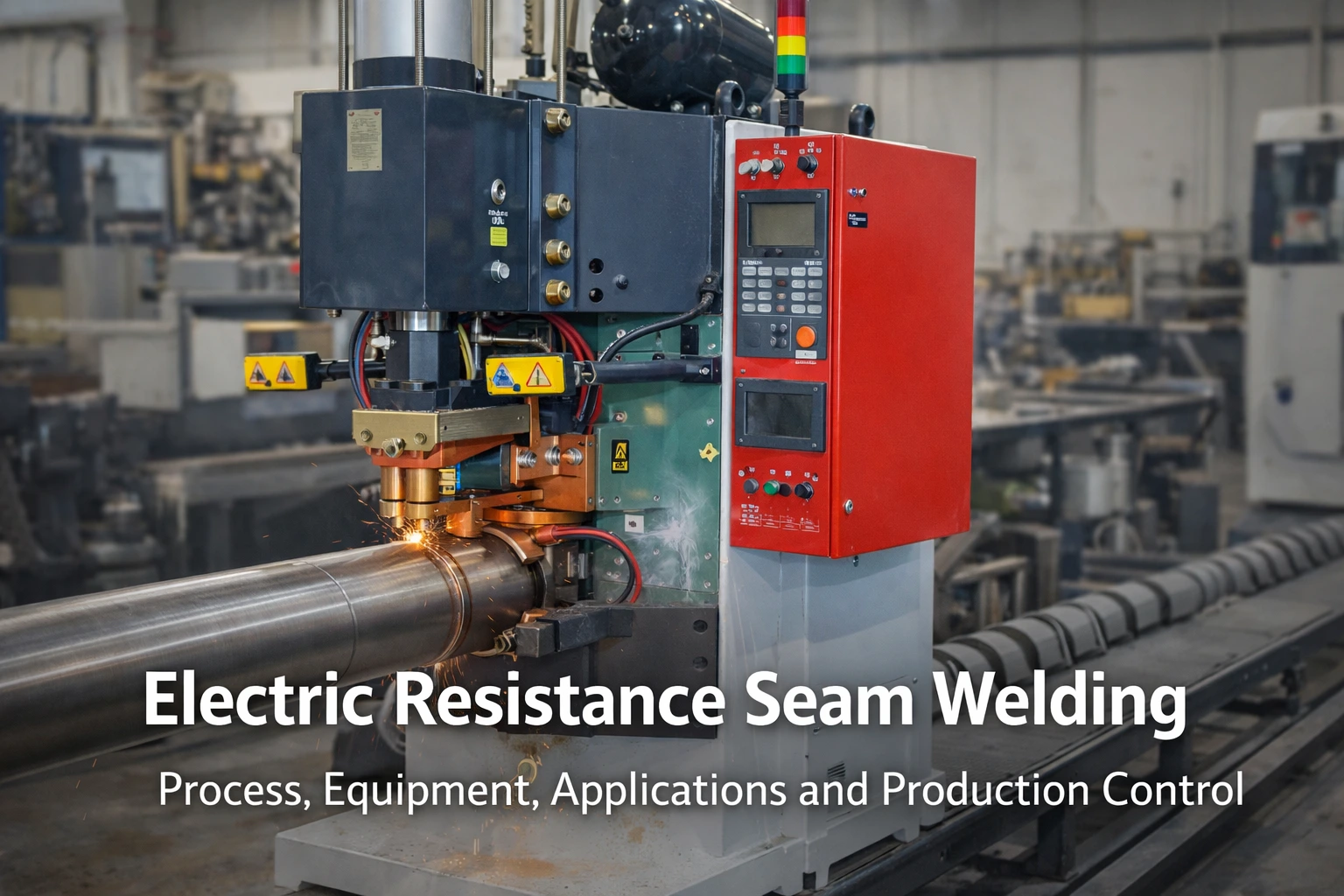
2. Seam Welding
In seam welding, rotating wheel electrodes create a continuous weld along a seam. It is commonly used for fuel tanks, pipes, and airtight containers.
3. Projection Welding
Projection welding uses embossed or pre-formed projections on the workpiece to concentrate current flow and ensure precise weld locations. It is ideal for fastening nuts, bolts, and structural components.
4. Flash Welding
Flash welding joins larger components by generating heat through flashing action at the interface before applying pressure.
5. High-Frequency Resistance Welding
Used primarily in pipe and tube manufacturing, this method utilizes high-frequency current to create continuous weld seams.
Industrial Applications of Electric Resistance Welding
Electric resistance welding plays a critical role in modern industrial production due to its efficiency and automation capability.
Automotive Industry
- Body-in-white assembly
- Door panels and chassis structures
- Battery pack welding in EV manufacturing
Electrical & Electronics
- Busbars
- Battery tabs and connectors
- Small precision components
Construction & Infrastructure
- Structural steel components
- Reinforcement assemblies
- HVAC ducting systems
Appliances & Consumer Goods
- Washing machine drums
- Refrigerator panels
- Metal furniture frames
Aerospace & Transportation
- Lightweight structural assemblies
- High-strength sheet metal components
Its versatility across thin-sheet and medium-gauge materials makes it indispensable in automated production environments.
Advantages of Electric Resistance Welding
Electric resistance welding offers several advantages that make it highly attractive for industrial manufacturers:
High Production Speed
Weld cycles are extremely fast, enabling high-volume production lines.
No Filler Materials Required
Reduces material cost and simplifies logistics.
Automation Friendly
Easily integrated into robotic and CNC-controlled systems.
Consistent Weld Quality
Provides repeatable, uniform welds with minimal operator dependency.
Clean Process
No smoke, slag, or filler contamination, improving factory cleanliness.
Energy Efficient
Heat is localized, reducing overall energy consumption.
Limitations of Electric Resistance Welding
While highly efficient, ERW has certain limitations:
- Primarily suitable for lap joints rather than butt joints
- Requires precise surface preparation for optimal conductivity
- High initial investment in specialized equipment
- Limited effectiveness on very thick materials
Understanding these constraints helps engineers choose the right welding method for their application.
Electric Resistance Welding vs Other Welding Methods
Compared to traditional welding technologies, ERW stands out in several key areas:
ERW vs Arc Welding
- ERW: No filler, faster cycle time, easier automation
- Arc welding: More flexible for complex joints but slower and operator-dependent
ERW vs Laser Welding
- ERW: Lower cost, simpler maintenance, excellent for mass production
- Laser welding: Higher precision but significantly more expensive
ERW vs Mechanical Fastening
- ERW: Permanent, lightweight joints without additional hardware
- Fastening: Removable but adds weight and assembly complexity
For high-volume manufacturing, ERW remains one of the most cost-effective joining solutions available.
Best Practices for Electric Resistance Welding in Industry
To achieve optimal performance, manufacturers should follow key engineering practices:
1. Proper Electrode Selection
Using the right electrode material ensures consistent conductivity and reduces wear.
2. Surface Preparation
Clean, oxide-free surfaces improve current flow and weld quality.
3. Parameter Optimization
Current, pressure, and weld time must be precisely controlled based on material type.
4. Regular Maintenance
Electrode dressing and machine calibration are essential for long-term stability.
5. Integration with Automation Systems
Modern factories benefit significantly from robotic welding cells and PLC-controlled systems for repeatability.
Heron Welder: Advanced Electric Resistance Welding Solutions
As a global manufacturer of industrial welding systems, Heron Welder provides cutting-edge electric resistance welding solutions designed for modern manufacturing environments.
Our portfolio includes:
- Spot welding machines for automotive and sheet metal applications
- Projection welding systems for precision fastening
- Seam welding equipment for continuous joints
- MFDC resistance welding machines for energy-efficient production
- Capacitor discharge welding systems for high-speed applications
- Automated welding production lines integrated with robotics and smart controls
Heron systems are engineered to deliver:
- High production efficiency
- Stable welding quality
- Reduced operational costs
- Seamless automation integration
- Long-term industrial reliability
By combining mechanical precision with advanced electrical control systems, Heron enables manufacturers to achieve scalable, future-ready production capabilities.
Frequently Asked Questions (FAQs)
1. What materials can be joined using electric resistance welding?
Electric resistance welding is commonly used for steel, stainless steel, aluminum (with specialized systems), and various conductive alloys.
2. Is electric resistance welding suitable for mass production?
Yes, ERW is one of the best welding methods for mass production due to its speed, automation compatibility, and repeatability.
3. What industries use electric resistance welding the most?
Automotive, appliance manufacturing, electrical equipment, construction, and metal fabrication industries rely heavily on ERW.
4. What is the difference between spot welding and seam welding?
Spot welding creates individual weld points, while seam welding produces continuous welds along a joint.
5. Can ERW be automated?
Yes, electric resistance welding is highly compatible with robotic systems and automated production lines.
Conclusion
Electric resistance welding continues to be a foundational technology in modern manufacturing, offering unmatched efficiency, consistency, and scalability for high-volume production environments. As industries evolve toward automation and smart factories, ERW systems play an even more critical role in ensuring production quality and cost optimization.
With advanced engineering expertise and a global manufacturing footprint, Heron Welder delivers reliable electric resistance welding solutions tailored for automotive, industrial, and OEM applications.
If you are looking to upgrade your production line, improve weld consistency, or implement fully automated welding systems, contact Heron Welder to request a customized solution or technical consultation today.



 English
 Arabic
 French
 Spanish
 Portuguese
 Deutsch
 Turkish
 Dutch
Dutch
 Italiano
 Russian
 Romaian
 Greek
Greek